
How to Choose the Best Wedding Date According to the Hindu Calendar 2025–2026

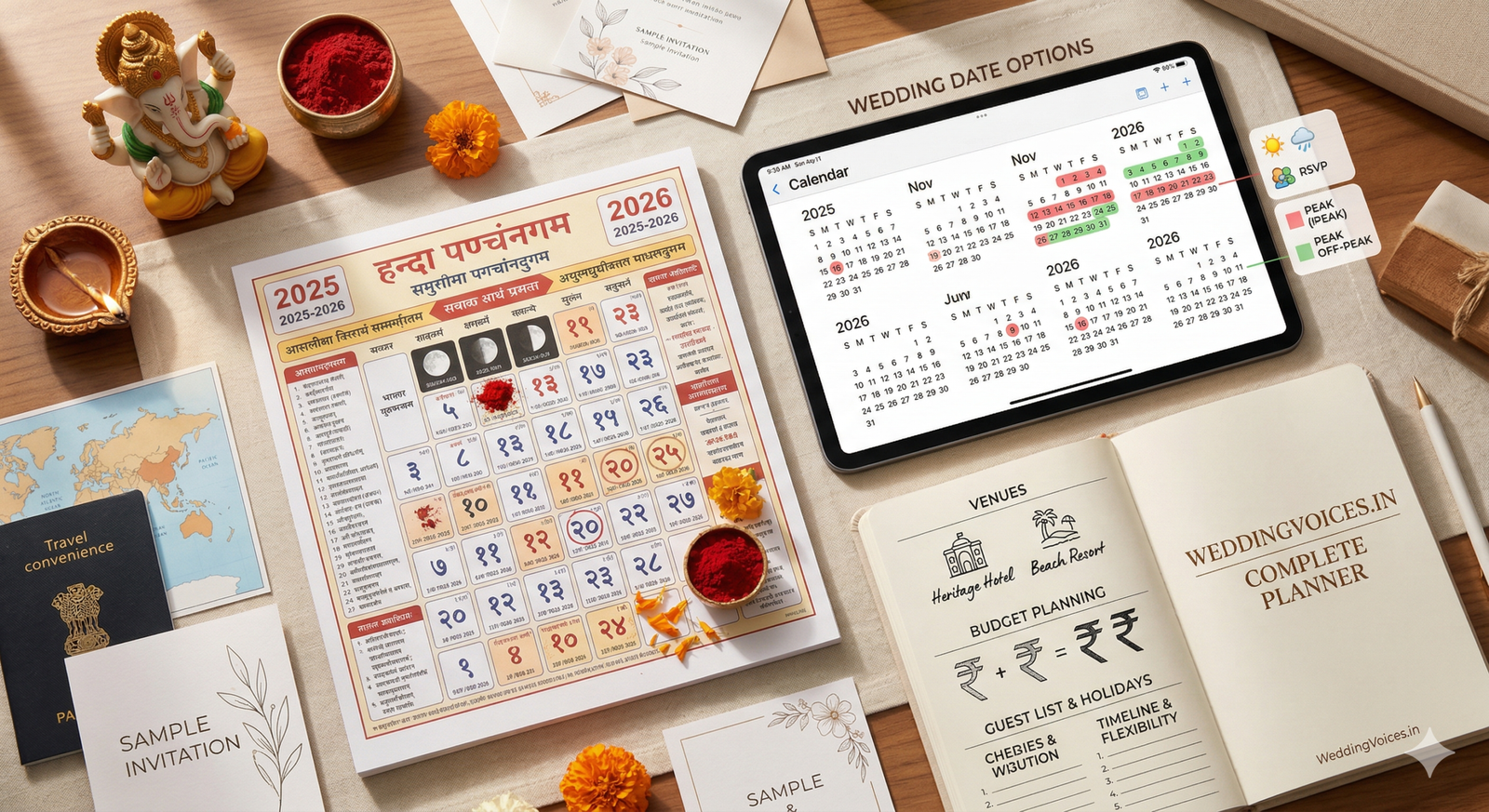
The journey to the mandap begins with a single, incredibly important decision: picking the day you will say “I do.” In Indian culture, a wedding is not just a union of two individuals, but a sacred alignment of stars, families, and lifelong destinies. For couples looking ahead to the upcoming wedding seasons, navigating the Hindu Calendar 2025–2026 is the first critical step.
However, modern wedding date selection is an intricate dance. Gone are the days when a priest simply handed a family a single date and everyone complied. Today’s couples must balance profound religious or cultural factors with practical, real-world logistics. How do you honor astrological traditions while also ensuring your dream venue is actually open?
How to Plan a Wedding in 3 Months on a Tight Budget
This comprehensive, step-by-step guide is designed to help you analyze the 2025 and 2026 Panchangam (Hindu calendar) while expertly navigating modern practicalities so you can secure a date that is both spiritually auspicious and logistically flawless.
Step 1: Understanding the 2025–2026 Hindu Calendar
Before looking at venues or drafting guest lists, you must understand how auspicious dates (Muhurthams) are generated. The Hindu calendar is lunar-based, meaning dates fluctuate wildly from the standard Gregorian calendar year to year.
The Science of the Shubh Muhurtham
A Shubh Muhurtham is an auspicious time slot calculated based on the couple’s birth stars (Nakshatras) and moon signs (Rasis). For the 2025–2026 wedding seasons, astrologers will look for periods where favorable planets (like Jupiter and Venus) are strongly positioned. Conversely, they will strictly avoid periods like Chaturmas (a four-month period usually between July and October) or Khar Maas (mid-December to mid-January), during which Hindu weddings are traditionally paused.
Because auspicious dates are limited, highly favorable days in peak months (like November 2025, February 2026, and May 2026) will see thousands of weddings happening simultaneously across the country.
Gathering Your Options
To begin, consult your family priest or astrologer with the birth details of both the bride and the groom. Do not ask for just one date. To survive the modern wedding industry, you must ask for at least three to five potential dates spread across different months. This is where the concept of flexibility becomes your greatest asset. If you become fixated on a single date, you may find yourself severely compromised when it comes to booking vendors.
Step 2: Navigating Seasonal Realities
Once you have a handful of astrologically approved dates, it is time to filter them through the lens of the physical world. India’s climate is diverse, and the season you choose will dictate everything from your bridal wear to your decor.
Weather Conditions and Your Vision
Carefully evaluate the weather conditions for your prospective dates. Are you dreaming of an outdoor, sunset pheras ceremony under a floral mandap? If the priest suggests a date in July 2025, you must consider the heavy monsoon rains that could wash out an open-air event. If you are given dates in May 2026, the sweltering summer heat means you must heavily prioritize indoor, air-conditioned venues to keep yourselves and your guests comfortable.
Peak vs Off-Peak Dates
Seasonal considerations directly impact the wedding economy. The Indian wedding season traditionally peaks during the winter months (November to February). The weather is cool, pleasant, and perfect for heavy silk sarees, velvet lehengas, and rich, spicy catering menus.
However, because these are highly sought-after, they are considered peak vs off-peak dates. Choosing a peak winter date means higher costs and brutal competition for top-tier professionals. If your astrologer provides an auspicious date during the off-peak summer or early monsoon months, you will likely find vendors are more available, more willing to negotiate, and generally less stressed.
Step 3: Mastering the Logistics and Finances
Your wedding date dictates your timeline, and your timeline dictates your budget. The moment your dates are shortlisted, you enter the logistical phase of planning.
Synchronizing Your Planning Timeline
A healthy planning timeline for an Indian wedding is typically 8 to 12 months. If it is currently early 2025 and your astrologer gives you a brilliant date just three months away, you need to realistically assess if you have the mental bandwidth and resources to pull it off. A shorter timeline requires rapid decision-making and often limits your options for custom designer wear and highly sought-after professionals.
The Battle for Venue Availability
In the Indian wedding industry, venue availability is the ultimate deciding factor. On days marked as “highly auspicious” in the 2025–2026 calendar, premium hotels, resorts, and banquet halls will book out over a year in advance.
Take your list of 3 to 5 dates from the priest and immediately call your top three dream venues. Often, the venue’s calendar will make the final decision for you. If your heart is set on a specific heritage property, you may need to choose your second-choice astrological date simply because the venue is already booked on your first choice.
Aligning Vendor Scheduling
Just like venues, elite photographers, celebrity makeup artists, and renowned decorators can only take on one wedding per day. Vendor scheduling is a massive hurdle on peak Muhurtham dates. If you have a makeup artist or photographer you absolutely must work with, you may need to cross-reference their availability with your priest’s list of dates before finalizing anything.
Strategic Budget Planning
Your chosen date has a massive impact on your wallet. Budget planning becomes much more aggressive if you select a peak date in December 2025. Because demand outstrips supply, venues and vendors charge premium rates, and discounts are virtually nonexistent. If budget is a primary concern for your family, deliberately asking your astrologer to find auspicious dates in the “shoulder seasons” (like late February or early March 2026) can save you lakhs of rupees, allowing you to reallocate those funds toward a better honeymoon or future investments.
Step 4: Ensuring Guest Experience and Attendance
A wedding is a community celebration. While the day is ultimately about the couple, celebrating with empty chairs because of poor planning is heartbreaking.
Checking Guest Availability and Calendars
Once you have your potential dates, discreetly check guest availability—specifically the VIPs. These are the immediate family members, best friends, and crucial elders without whom the wedding simply cannot happen.
You must heavily consider work and school calendars. If you choose a date in the middle of March 2026, you will likely clash with crucial board exams in India. Families with teenagers may be forced to decline your invitation or leave the celebrations early. Similarly, mid-week weddings are notoriously difficult for working professionals to attend fully. If your Muhurtham falls on a Wednesday, expect a lower turnout for your daytime events like the Haldi and Mehendi.
Avoiding Holiday and Special Events
Cross-reference your potential wedding dates with the broader 2025–2026 public calendar. Be wary of a holiday and special events clash. While a long weekend (like around Independence Day or Diwali) might seem like a great idea for a wedding, it can backfire. Your guests might have pre-existing annual family vacation traditions. Furthermore, booking hotels and flights during major national holidays is incredibly expensive, which puts an unfair financial burden on your attendees.
Prioritizing Travel Convenience
Indian weddings are increasingly becoming destination affairs, or at the very least, involve a significant portion of guests flying in from different states or countries (like NRIs traveling from the US, UK, or UAE). Travel convenience must be evaluated. Look at flight schedules and costs around your prospective dates. If you pick a date that requires your guests to travel during peak international holiday seasons (like late December), their airfare will be exorbitant. Choose dates where travel is smoother and hotel blocks are easier to negotiate.
Step 5: Adding the Final Layer of Meaning
Astrology, budgets, and logistics will significantly narrow down your options. However, if you are lucky enough to have two equally viable dates remaining on your list, it is time to look inward.
Finding Personal Significance
Does one of the dates hold personal significance? Perhaps one of the astrologically approved days in 2026 happens to fall on the exact anniversary of the day you and your partner first met, or on the wedding anniversary of your grandparents. Infusing the calendar with your own personal history adds a beautiful, emotional layer of storytelling to your celebration.
Summary: The Formula for the Perfect Wedding Date
Choosing a wedding date for 2025 or 2026 is not a single decision; it is a strategic process of elimination. To ensure a seamless, beautiful celebration, follow this hierarchy:
-
Consult the Stars: Begin with the Hindu Calendar to fulfill all religious or cultural factors and get a list of 3 to 5 auspicious dates.
-
Check the Big Tickets: Immediately cross-reference those dates with venue availability and critical vendor scheduling.
-
Analyze the Real World: Filter the remaining dates through weather conditions and your overall budget planning strategy, being mindful of peak vs off-peak dates.
-
Consider Your People: Ensure high guest availability by checking work and school calendars, verifying travel convenience, and avoiding major holiday and special events.
-
Commit: Once you find the date that survives this gauntlet, lock it in. Embrace flexibility if things shift, and immediately build your planning timeline around your final choice.
By balancing the sacred wisdom of the Panchangam with practical, modern-day event management, you will lay the perfect foundation for the most magical day of your life.
60+ tasks from engagement to vidaai, grouped by month. Tick them off — your progress is saved on this device.

Written by
Thalla Lokesh
Part of the Wedding Voices editorial team, writing about real weddings, planning and ideas for couples.